How to Do Things With International Law by Ian Hurd
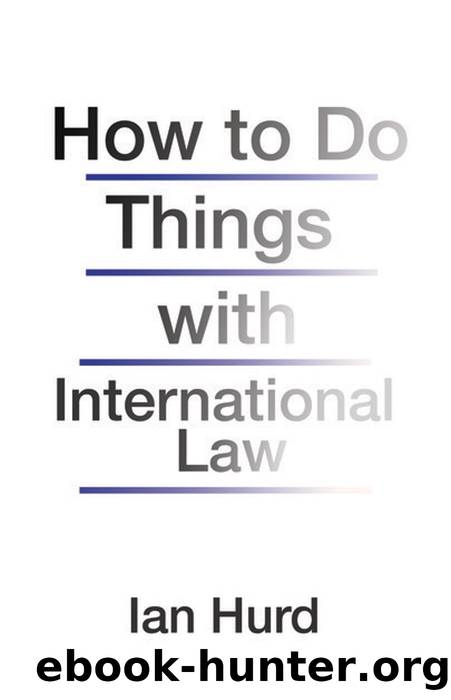
Author:Ian Hurd [Hurd, Ian]
Language: eng
Format: epub
Tags: International Relations, Treaties, International, Political Science, World, Geopolitics, Law, General
ISBN: 9780691196503
Google: AcmXDwAAQBAJ
Goodreads: 44526090
Publisher: Princeton University Press
Published: 2019-08-27T00:00:00+00:00
Torture in International Humanitarian Law
There is no doubt that torture is prohibited by international law. The universe of international human rights law and norms contains many prohibitions on torture across all classical sources of international law, from treaties to customary law to jus cogens, with the effect that no state exists in a legal condition in which torture is not illegal.11 The specific content of the prohibition is constituted by the particular terms and application of these rules, and so their effect on domestic and international politics depends on what they say, how they have been interpreted, and how they have been put to use.
The Universal Declaration of Human Rights includes the clear statement that âno one shall be subjected to torture or to cruel, inhuman or degrading treatment or punishmentâ (Art. 5). This was repeated in the International Covenant on Civil and Political Rights and the American Convention on Human Rights of 1969.12 These are specific incarnations of the more general statement in the UN Charter that its member states âreaffirm faith in fundamental human rights.â13 These treaties, however, do not frame their subject in terms of specific legal obligations binding on signatories, and so they are not of a type that can be complied with or violated; they describe what they say are the aspirations of the signatories or international community.
The key documents for contemporary legal debates are the Convention against Torture (CAT), adopted in 1984 after negotiations in the UN General Assembly, and the Geneva Conventions of 1949, particularly Article 3 on the treatment of people in noninternational conflicts. The CAT defines torture as âany act by which severe pain or suffering, whether physical or mental, is intentionally inflicted on a person for such purposes as obtaining from him ⦠information or a confession, punishing him â¦, or intimidating or coercing him â¦, when such pain or suffering is inflicted by or at the instigation of ⦠a public official or other person acting in an official capacityâ (Art. 1). It requires that a signatory state âtake effective legislative, administrative, judicial or other measures to prevent acts of torture in any territory under its jurisdictionâ (Art. 2), and âensure that all acts of torture are offenses under its criminal lawâ (Art. 4).
The Geneva Conventions of 1949 prohibit âviolence to life and person, in particular murder of all kinds, mutilation, cruel treatment and tortureâ (3rd, 3[i]a), and âoutrages upon personal dignity, in particular, humiliating and degrading treatmentâ (3rd, 3[i] c). These apply in cases of declared war among contracting parties (Art. 2) as well as conflicts of a noninternational character (Art. 3). This is the set of treaties that includes the three earlier Geneva Conventions (of 1864, 1906, and 1929) and adds a fourth, and has been ratified by every member of the United Nations; this makes it the centerpiece of international human rights law as it applies to behavior in the context of war and other armed conflict. The CAT goes further, making it clear that âno
Download
This site does not store any files on its server. We only index and link to content provided by other sites. Please contact the content providers to delete copyright contents if any and email us, we'll remove relevant links or contents immediately.
| Arms Control | Diplomacy |
| Security | Trades & Tariffs |
| Treaties | African |
| Asian | Australian & Oceanian |
| Canadian | Caribbean & Latin American |
| European | Middle Eastern |
| Russian & Former Soviet Union |
The Secret History by Donna Tartt(19086)
The Social Justice Warrior Handbook by Lisa De Pasquale(12190)
Thirteen Reasons Why by Jay Asher(8909)
This Is How You Lose Her by Junot Diaz(6885)
Weapons of Math Destruction by Cathy O'Neil(6279)
Zero to One by Peter Thiel(5801)
Beartown by Fredrik Backman(5754)
The Myth of the Strong Leader by Archie Brown(5507)
The Fire Next Time by James Baldwin(5442)
How Democracies Die by Steven Levitsky & Daniel Ziblatt(5218)
Promise Me, Dad by Joe Biden(5153)
Stone's Rules by Roger Stone(5087)
A Higher Loyalty: Truth, Lies, and Leadership by James Comey(4960)
100 Deadly Skills by Clint Emerson(4924)
Rise and Kill First by Ronen Bergman(4788)
Secrecy World by Jake Bernstein(4752)
The David Icke Guide to the Global Conspiracy (and how to end it) by David Icke(4717)
The Farm by Tom Rob Smith(4507)
The Doomsday Machine by Daniel Ellsberg(4490)
